The Five Little Cats
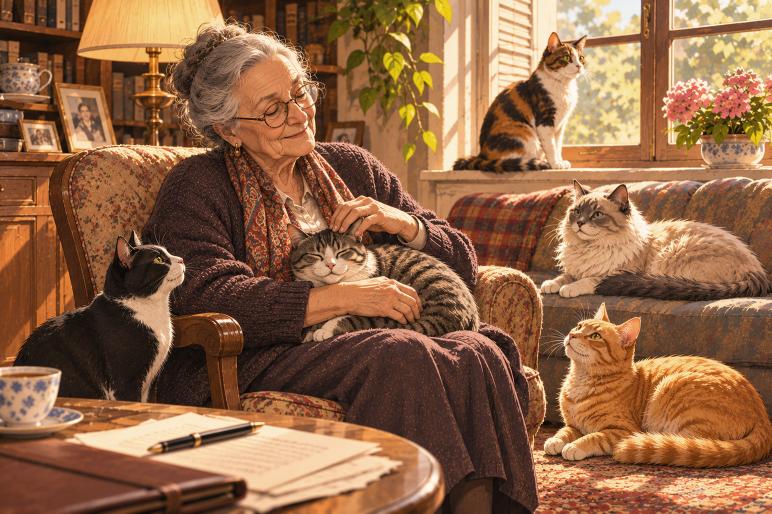
When I opened that will, I found five female names.
Five names, each accompanied by a careful description: the colour of her fur, the colour of her eyes, the distinctive features that made it possible to identify each of the five recipients of such loving care beyond any doubt.
They were not the deceased woman's daughters, granddaughters or friends.
They were five cats.
Or, to use the affectionate expression the lady had chosen in her will, her “five little kitties”.
Over the course of a long professional career, one comes across all kinds of testamentary provisions. Some are very straightforward, others complex, and still others surprising. But there are wills that, more eloquently than any number of words, reveal the personality, affections and even the everyday life of the person who wrote them.
This was one of those wills.
The lady had wanted to make sure that, after her death, the five cats that had kept her company during the final years of her life would not be left without protection.
She had listed them one by one, calling each by name and describing them with a precision that showed just how well she knew them and how much they meant to her.
And she had provided for a monetary legacy to her nephew, entrusting him with the task of looking after her beloved kitties and even assigning him, in her own words, the role of their “guardian”.
The word did not, of course, carry the legal meaning it has when we speak of guardianship of individuals. But it expressed perfectly what this woman wanted: someone should continue to protect her little companions in life.
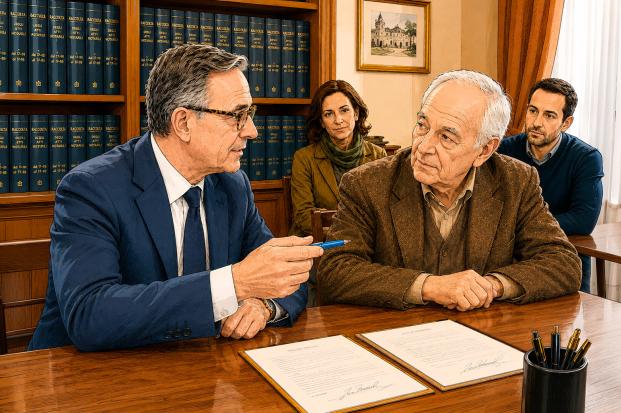
When I had finished reading those provisions, I looked up at the nephew sitting opposite me.
I asked him how the five little cats were doing.
He explained that, sadly, one of them was no longer alive. The will had been written some time earlier, and one of the five cats had since died.
The other four, however, were doing well.
Most importantly, he told me that his wife had always looked after them and continued to care for them with affection.
I must admit that his answer brought a broad smile to my face.
In the end, the lady had achieved exactly what she had wanted.
Her little cats were safe.
And that will, which might have seemed unusual to someone reading it merely as a legal document, had a deeply meaningful yet very simple purpose: her determination not to abandon, even after death, the creatures to whom she had devoted so much affection.
It was not the first time I had encountered something of this kind.
Years earlier, a lady had asked me to draw up her will.
She was especially fond of a cat who clearly meant the world to her.
At one point, she expressed a wish that, in its simplicity, made me smile: she wanted to name her cat as her heir.
Naturally, I had to explain that this was not possible.
An animal, however dearly loved, cannot be appointed an heir. Under Italian law, animals do not possess the legal capacity required to inherit an estate directly.
But that did not mean there was no way to give effect to the lady's wishes.
I explained that we could identify a person or organisation legally capable of inheriting, and entrust them with the responsibility of ensuring the animal's welfare.
And that is what we did.
The lady decided to leave her estate to an animal welfare association in Casale Monferrato, with provisions directing that her assets be used to provide her cat with all the care and assistance it needed for the rest of its life.
She had also thought about what would happen afterwards.
Once the cat had died, whatever remained was to be used to care for the city's colonies of stray cats.
I thought it was a particularly beautiful solution.
This woman had not simply been concerned about her own pet. She wanted the affection that had accompanied her throughout her life to become, one day, a source of help for other cats as well.
I remember how happy she was with this arrangement.
When she subsequently passed away, her will was formally published and her wishes were carried out.
The cat spent the final years of its life happily cared for by the association.
Once again, then, a will had served a purpose that went far beyond the mere distribution of an estate.
It had ensured that a bond of affection would endure.
Thinking back on these episodes, I find myself reflecting on something.
In the course of our profession, we meet a great many elderly people, particularly women.
This is no coincidence. Demographic statistics remind us that women live longer than men on average and that, in the oldest age groups, women outnumber men.
Many of the ladies we meet have been widowed for years. Others have never married, while others still have had no children.
Of course, not all of them live alone, and not all experience solitude in the same way.
But for some, especially as the years pass and social contacts become fewer, the presence of a pet takes on extraordinary importance.
A cat, a dog, sometimes several animals.
They are not simply another presence in the home.
They become daily companions, a comforting routine, a reason to get up in the morning, to prepare something, to take care of someone.
Some people spend much of the day without speaking to another human being.
Yet they have a cat waiting for them, coming close when they sit down, recognising their voice, sharing the small rituals of everyday life.
Or a dog that follows them from room to room, welcomes them home, demands attention and, simply by being there, makes the days feel less silent.
Anyone who has shared their life with an animal knows this bond very well.
A bond built on gestures, routines and mutual attentiveness.
And, above all, on affection that needs few words.
Animals know nothing of our social conventions. They have no interest in our possessions and do not judge people by their success, wealth or importance.
What they know is presence, care and familiarity.
And they return affection in their own way, with a spontaneity and unconditional warmth that can be quite extraordinary.
We should not be surprised, then, if an elderly person who may have spent many years living almost exclusively with a cat or dog becomes seriously concerned about what will happen to that animal after their death.
Indeed, I find that concern entirely understandable.
When you live alone, you become particularly aware of how important it is to know that someone will take care of those who depend on you.
And the thought of leaving a beloved animal without care can become a source of genuine anguish.
A pet cannot understand a will. It cannot know that its owner has died. It cannot ask someone to uphold its rights.
It depends entirely on the human beings around it.
And so, for its owner, a will becomes a means of trying to secure its future.
Naturally, the notary must translate these intentions into legally valid provisions, identify individuals or organisations capable of undertaking the relevant obligations, and devise arrangements that can actually be implemented.
But first and foremost, the notary must understand what the testator wants.
And must not dismiss a wish as eccentric simply because it does not directly concern a child, a grandchild or another family member.
After all, what is so strange about wanting to protect a living creature to whom one has given so much love?
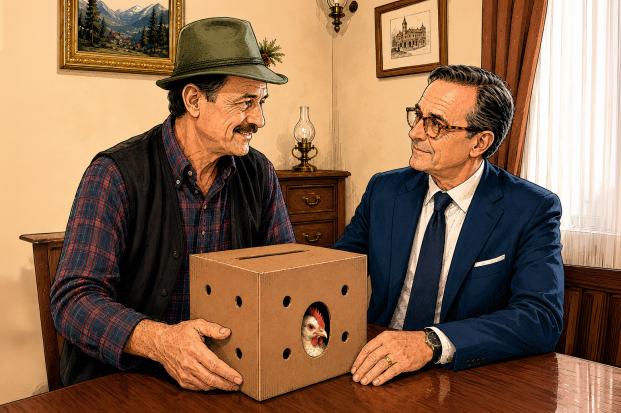
In another account from my professional life, I recalled a farmer and his dog, bound by a profound relationship that sadly ended in tragic circumstances.
But the bond between human beings and their animals also has this gentler, sometimes even quietly amusing, side.
The image of a lady carefully describing her five little kitties in her will, as though to make absolutely sure nobody could mistake one for another.
Or that of another lady who, quite naturally, asks the notary to name her cat as her heir.
These episodes made me smile, but they also taught me something.
We often tend to measure the importance of a will by the value of the assets it contains.
A house, a plot of land, a bank account, wealth accumulated over a lifetime.
And yet, sometimes, the most important part of a will has nothing to do with money itself.
It has to do with what that money is meant to make possible.
Taking care of someone.
Not forgetting a bond of affection.
Continuing, as far as possible, to protect those who have shared our lives.
I like to think that when that lady wrote down the names of her five little cats, she was not merely deciding how to dispose of her property.
She was thinking of each of them, of their future, of the home they had shared, of the routines they had enjoyed together.
And, above all, of how to make sure that, after she was gone, someone would continue to love them.
When her nephew told me that four of the five cats were still alive, were doing well and were being lovingly cared for by his wife, I felt a genuine sense of satisfaction.
Not because the legal instrument was complex. In fact, it presented no particular difficulties.
But because, once again, I had seen how profoundly a will can reveal the human heart.
And how much love can lie behind provisions that, at first glance, might seem merely curious.
The lady with the five little kitties was no longer there.
But someone was still looking after them.
And perhaps, of all her last wishes, that was the one she cared about most.