Twelve Kilometres
There are notarial deeds that take ten minutes, perhaps a quarter of an hour. And there are encounters that last much longer, because at a certain point you realise that the deed itself is, after all, merely the reason two people have found themselves face to face.
One Saturday morning some time ago, I had one of those encounters.
More and more often, in my profession, I find myself dealing with vulnerable people. Many are elderly, and often they are women. People who have lived a whole lifetime, known love, sacrifice, fulfilment and disappointment, and who, having reached an age when they should above all be entitled to peace, instead find themselves facing difficulties that seem never to end.
The woman I met that Saturday is called Michèle.
She is eighty-six and has a quality that struck me from our very first meeting, some fifteen years ago: she speaks Italian with a beautiful French accent. An accent that time has not erased, especially that unmistakably French r, which, for someone like me who deeply loves the language, has a particular charm.
She has never come to my office.
When she needs me, she telephones, and I go to her home. It has always been that way.
That Saturday, too, I got into my car and drove to see her in a small village near Casale Monferrato.
I walked across the courtyard of an old public housing building. A shabby courtyard, surrounded by a building bearing all the marks of neglect and age. One of those places where you immediately sense how difficult life can be for the people who live there.
Michèle lives there, in a very modest flat, surrounded by people she does not know and with whom she has virtually no contact.
She hardly ever goes out.
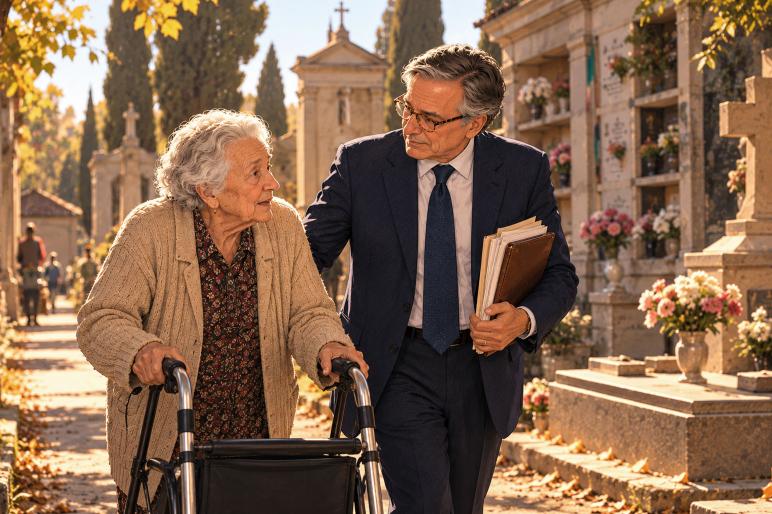
She needs a walking frame to get around and, if she wants to leave home, she must rely on someone to accompany her, sometimes turning to the Red Cross or voluntary organisations.
And yet her life has not always been like this.
For fifty years she lived alongside her husband. They also worked together, running a small textile business specialising in embroidery and sewing. One of those little enterprises in which work and family life become almost inseparable.
Three years ago, severe flooding struck the village where they lived. Their house stood in the lower part of the village, and the water rose to a height of a metre and a half, leaving it uninhabitable.
They were forced to leave, and Michèle ended up in the public housing flat where I went to visit her.
But the worst was still to come.
This summer she was diagnosed with lung cancer. She was admitted to hospital as an emergency and underwent surgery.
Her husband, who had long been seriously ill and was now bedridden, could no longer be left alone. Until then she had cared for him day and night, getting up repeatedly during the night to attend to his needs.
Once she was admitted to hospital, that became impossible.
Social services therefore arranged for her husband to be moved to a care home near Casale.
Michèle could not go with him. She was in hospital, struggling with her own illness, and could not even visit him.
A month later, social workers came to the hospital to tell her that her husband had died.
Fifty years of life together.
Fifty years of work, shared routines, worries and small everyday gestures.
And then, suddenly, the end.
Without being able to care for him in his final days. Without being beside him when he died. Without even seeing him one last time.
She had only managed to leave hospital to attend his funeral.
As she told me all this, with her unmistakable French r, I tried to imagine what it must mean for an eighty-six-year-old woman to lose, in such a way, the person with whom she had shared practically her entire life.
And yet Michèle is not a woman who gives up easily.
Despite her illness, her bereavement and her financial difficulties, over these past months she has found the strength to begin putting the flood-damaged house back in order. She has repaired the kitchen, tidied up as much as she could and made a bedroom on the ground floor, where the sitting room used to be, because the stairs have now become an insurmountable obstacle for her.
As I listened, it was precisely this contrast that struck me: a woman so physically frail, dependent on a walking frame, yet still capable of summoning an extraordinary determination to carry on.
She had called me because she needed to renounce her husband's inheritance.
Their former business had left behind debts dating back many years, which had since grown. So this problem, yet another in a long series, also had to be dealt with.
From a professional point of view, it was a relatively straightforward deed.
Ten minutes, perhaps fifteen.
But almost immediately I realised that Michèle had not called me simply to sign a document.
She needed to tell her story.
To talk about her husband, her illness, the flooded house, her loneliness. About a life that seemed to have slipped out of her hands in the space of just a few months.
And above all, she needed someone to listen.
So I stayed with her for more than forty minutes, sitting in her home, listening to the story of a life.
I had no particular advice to offer. I could not bring back her husband, take away her illness or solve the difficulties of her life with a few words.
All I could do was listen.
At one point she said to me, with a sadness that was entirely untheatrical:
“But what am I still here for now? I'm alone. I have no one left.”
And as she spoke those words, two tears welled up in her eyes.
Just two.
I saw them clearly.
No more words were needed to understand the weight of her loneliness. Those two tears, in a woman who until then had recounted her misfortunes with such strength, left a deep impression on me.
And yet, a few minutes later, that same woman was telling me about the work she had done on the house, the kitchen she had managed to put right, the bedroom she had created on the ground floor.
Life, evidently, was still finding a way through all that pain.
Then we began talking about the cemetery.
She had wanted her husband buried in his home village, near his parents and his brother. A small cemetery about ten kilometres from where she now lives.
An insignificant distance for anyone with a car.
For her, however, an almost impossible journey.
She explained that she no longer knew how to get there. She could not drive, could not use public transport on her own and had to rely on support services or the kindness of a volunteer whenever she needed to go anywhere.
She told me how terribly sad she was that she could not visit her husband.
It was then that, without thinking too much about it, I said:
“Please don't worry, madam. I'll come and pick you up. I'll take you to the cemetery whenever you like. You needn't worry about that.”
I had not planned those words. They came naturally.
And then I saw something change in her face.
A smile.
And above all, a flash of gratitude in her eyes.
She thanked me in that beautiful French-accented voice of hers, and I had the feeling that, for a moment, the burden of her loneliness had become a little less unbearable.
After all, I had only offered her a lift in my car.
Twelve kilometres, more or less.
Such a tiny thing compared with everything she had been through.
But for her those twelve kilometres meant the chance to be close once again to the man with whom she had shared fifty years of her life.
Thinking back on that encounter, I realised once again what an unusual profession ours is.
As notaries, we constantly enter people's lives. Often at their most important moments, but also at their most painful. We meet people buying their first home, young people setting up businesses, parents wishing to arrange their affairs for their children. But we also meet people who are alone, elderly or ill, who bring with them far more than the documents needed for a deed.
They bring their stories.
And sometimes those stories need to be told.
Yet these people cannot always come to our offices.
Sometimes we have to go to them.
For me, doing so has always felt natural. When someone who is elderly, ill or unable to travel needs a notary, I get into my car and go to their home.
I have done it throughout my professional life, and I will continue to do so for as long as I practise.
Perhaps even afterwards, when I am no longer a notary.
Because some gestures belong to our profession, while others belong, quite simply, to life.
I do not believe a notary should become a psychologist, or that we can take responsibility for every problem faced by the people we meet.
But I do believe we must retain the ability to recognise vulnerability when it is before us.
Not always to be in a hurry.
To understand when, even before a legal answer, someone needs to be heard.
To enter other people's lives gently, with respect, understanding and, when possible, a small, practical act of kindness.
On Saturday, I crossed the shabby courtyard of an old public housing building to formalise an eighty-six-year-old woman's renunciation of an inheritance.
The deed probably took a quarter of an hour.
But what has stayed with me from that encounter is not the renunciation.
It is those two tears that appeared in her eyes when she told me she had no one left.
And it is those same eyes, lit up by a smile, when I promised to take her to the cemetery.
Because those twelve kilometres, which for me are no more than a short drive, mean that she can return, once again, to her husband's side.