Behind a closed door
There are aspects of the notarial profession that are difficult for anyone outside it to truly understand.
In most people's minds, a notary is the professional who draws up deeds, executes contracts, certifies signatures and deals with property transactions, inheritances and companies. All of that is true, of course. But it is only part of what we do.
Anyone who practises this profession for many years—and in my case it has now been a long professional life—ends up witnessing, almost without realising it, every season of human existence.
We encounter the joy of someone buying their first home, the enthusiasm of someone starting a business, the peace of mind of someone wishing to arrange their affairs for their children. But we also encounter suffering, loneliness, illness and, inevitably, death.
Above all, we encounter vulnerability.
Vulnerability has many faces and can reveal itself in countless different ways.
We sometimes visit very elderly people in their homes, some with impaired vision or no sight at all. We meet people living with serious neurological conditions who struggle to express themselves, to communicate and sometimes even to perform the simplest movements.
Yet even in these circumstances, they still need to undertake important legal acts.
Sometimes we are called upon to record their last wishes. At other times, we must draw up a power of attorney so that a property can be sold—perhaps the only asset they have left—with the proceeds needed to pay for residential care or assistance.
In such situations, our work becomes particularly delicate.
Knowing the law is not enough. We must understand the person before us, respect their pace, listen patiently and distinguish physical or communication difficulties from their ability to understand and consciously express their wishes.
We need to draw not only on our professional expertise but also on all the human sensitivity we can muster.
There are encounters in which the most important quality of a notary is not the speed with which a deed can be completed, but the patience with which the notary can listen.
And among the many forms of human vulnerability, one has particularly struck me over the years: the kind that lies hidden behind the closed doors of our homes.
It is a vulnerability often accompanied by loneliness, isolation and, sometimes, a disorder that manifests itself in the uncontrolled accumulation of possessions.
What is commonly known as compulsive hoarding.
On several occasions, I have entered homes where this condition had reached astonishing proportions. Indeed, in the past six months alone, I have encountered at least two such situations.
These are experiences that are difficult to forget.
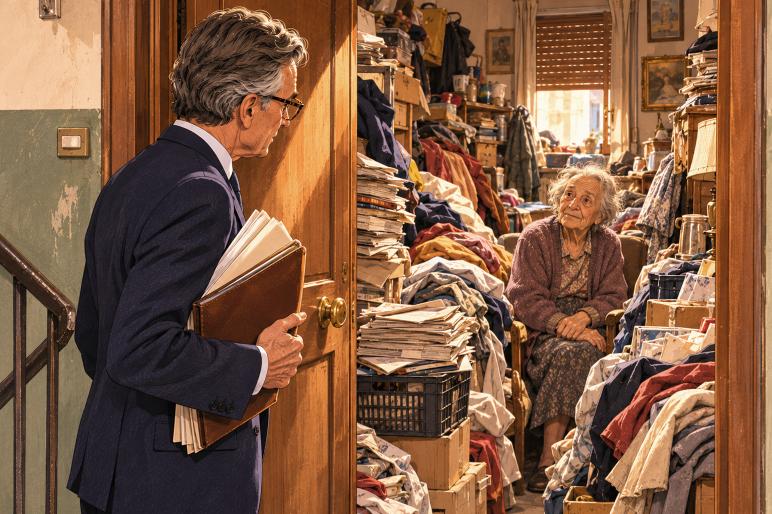
You arrive at what appears to be an ordinary home. A home like any other, perhaps in an apartment building, on a street you travel along every day.
From the outside, there may be nothing unusual to see.
The windows are closed, the door is shut, and the life taking place inside remains entirely unknown.
Then that door opens.
And you discover a world you could scarcely have imagined.
The rooms are no longer really rooms, at least not in the sense in which we normally understand them.
The wardrobes are full, but clothes are no longer put away inside them. Instead, they pile up on the floor, one on top of another, forming veritable hills that can reach halfway up the walls.
Corridors become narrow pathways cut through mountains of possessions.
Bathrooms are filled with plastic bottles, containers of every kind, bags and materials stacked wherever there is space.
Then there are crates, large glass demijohns, boxes, books, newspapers, magazines, old clothes and an endless quantity of things whose origins eventually become impossible even to imagine.
These are not simply untidy people, nor are they merely people who are particularly attached to their memories.
In some cases, the accumulation has become something far deeper and much harder to control.
Objects keep coming into the house, but virtually nothing ever leaves.
Sometimes they are not even things the person bought or once owned. They are objects picked up in the street, retrieved from rubbish bins, items discarded by others and brought home, where they are added to everything already there.
The process unfolds slowly, day after day, year after year.
First, a wardrobe fills up. Then a room. Then the corridor, the kitchen, the bathroom.
In the end, paradoxically, it is almost as though the objects have taken possession of the home, forcing the person who lives there to retreat into an ever smaller space.
I have seen homes where moving about meant weaving from side to side, trying not to trip, threading a way between heaps of clothing and stacks of newspapers.
And I myself have stood there with documents in my hands, struggling to find a corner of a table clear enough to put down a sheet of paper and have a power of attorney signed.
Told like this, the situation might even seem absurd.
But when you are inside such a home, there is absolutely nothing amusing about it.
Because you realise that what you are seeing is not simply a messy house.
It is the visible sign of suffering, of a condition that may have developed over many years until it profoundly disrupted everyday life.
Naturally, it is not a notary's place to make diagnoses. But you do not need to be a doctor to understand that when someone can no longer use their own home normally, it is not a matter of mere eccentricity.
In some cases, the accumulation is so extensive that even cleaning the rooms becomes almost impossible.
Hygiene gradually deteriorates. Spaces become inaccessible. The home, which should be a place of protection, safety and peace, becomes an environment in which even the most basic tasks of daily life are difficult.
Recently, I was personally involved in an especially serious case.
To help someone living in these conditions, it became necessary to arrange the clearance of a large apartment.
I called in people to empty it.
In the end, removing everything accumulated over the years required more than thirty truckloads of material destined for disposal.
Thirty truckloads.
Clothes, bags, objects of every description, materials no longer usable, waste.
And despite the scale of that undertaking, the home still needs to be thoroughly cleaned.
When I think back to that extraordinary quantity of things, I wonder how many times that person must have walked through the streets of their town, picking something up, carrying it home, finding a place for it and adding it to everything they already had.
Above all, I wonder how many years they lived in those conditions.
Because a house does not fill up like that in a week or a month.
It is a process that can take years, sometimes decades.
A gradual shrinking of the space in which a person lives, often accompanied by an equally gradual narrowing of their contact with the outside world.
And that is precisely what strikes me most.
These people live among us.
They are not necessarily in distant, abandoned or isolated places.
They may live on our street, in our apartment building, perhaps just two doors away.
We occasionally meet them when they go out shopping. We see them crossing a courtyard or walking along a pavement.
Perhaps we barely know their names.
Then they go home, close the door and disappear from our sight once again.
And we carry on with our lives.
I find it hard to believe that, over so many years, no one could have had even the slightest suspicion that something was wrong.
A neighbour, an acquaintance, someone who noticed unusual behaviour, increasing isolation, an unspoken need for help.
And yet these situations can continue for a very long time without anyone truly managing to intervene.
This leads me to a broader reflection on the society in which we live.
We have multiplied our means of communication. We are constantly reachable. At any moment, we can speak to people living on the other side of the world.
And yet we risk no longer knowing the people who live next door.
We have grown accustomed to thinking that what happens behind someone else's door is none of our concern.
Of course, there is a right to privacy, and it must be respected. No one is entitled to intrude into another person's private life uninvited.
But respect for privacy should not become indifference.
There is a profound difference between respecting someone's wish to be alone and abandoning them to their loneliness.
And sometimes I feel that we are losing sight of that difference.
That is also why I regard our profession, in certain respects, as a privileged vantage point from which to observe the human condition.
A notary, especially when visiting people in their own homes, encounters situations that normally remain unseen.
We do not merely encounter assets to be transferred, estates to be settled or documents to be signed.
We encounter people.
And sometimes we meet them when their lives have reached a point of extreme difficulty.
On some occasions, we arrive while there is still something we can do.
Not necessarily by drawing up a notarial deed.
As happened to me recently, we may be able to help someone regain more dignified living conditions by involving people who can offer practical assistance.
At such moments, the boundary between professional duty and simple human solidarity becomes very thin.
It is not about taking the place of social workers, doctors or the relevant authorities.
It is, quite simply, about not looking the other way.
At other times, we arrive too late.
We enter those homes when the people who lived there are no longer with us.
And what remains is a house completely overwhelmed by possessions, where it seems impossible that anyone could have been living until so recently.
We look at those rooms, those heaps, those almost impassable pathways, and try to imagine the life of the person who lived among them.
The difficulties they endured.
How much they suffered.
How often they might have needed someone to notice their plight.
And then the house no longer appears to be merely an enormous container of useless things.
It becomes the silent testimony of a life.
A life that may, for many years, have unfolded in full view of everyone, without anyone ever truly seeing it.
I do not wish to judge these people. On the contrary, I believe that situations like these should teach us to suspend judgment.
When you enter a home overwhelmed by objects, it is easy to feel astonishment, discomfort, even disbelief.
What is much harder is to ask what might have led someone to live in that way.
And to recognise that behind what seems incomprehensible to us, there may be genuine suffering.
After so many years in the profession, I still believe that, alongside legal expertise, our work requires a particular attentiveness to other human beings.
We are not doctors, psychologists or social workers.
But by the very nature of our work, we are called into other people's lives at moments of great vulnerability.
And when that door opens, we have a moral duty to see not only the task we have to perform, but also the person standing before us.
To listen, to understand, to respect.
And, when we can, to help.
Because sometimes, being a good notary involves more than finding a clear space on a table so that someone can sign a power of attorney.
It means being able to see, behind all those accumulated possessions, the human being at risk of disappearing beneath them.
And remembering that, before being a professional, a notary is simply one human being encountering others.
With all their vulnerabilities.
And with all the dignity they deserve.
Continue reading