The corridor of silence
Over the course of my professional life, I often visit residential care homes. As the population grows older, it is becoming increasingly common for me to be called upon to assist elderly people who are no longer able to come to the notarial office themselves.
In most cases, I am asked to execute a power of attorney so that family members can deal more easily with the practical aspects of everyday life. On other occasions, however, I am called to receive a public will.
These are delicate matters. They require time, careful listening and, above all, respect for the dignity of the person sitting before you.
Over the years, I have visited dozens of care homes. I have come to know that environment well. Normally, the corridors are lively. You see residents sitting in communal rooms, relatives visiting, healthcare professionals, nurses and volunteers. Someone greets you. Someone else stops for a few words. Despite the frailties of those who live there, life continues.
One day, however, I had an experience I will never forget.
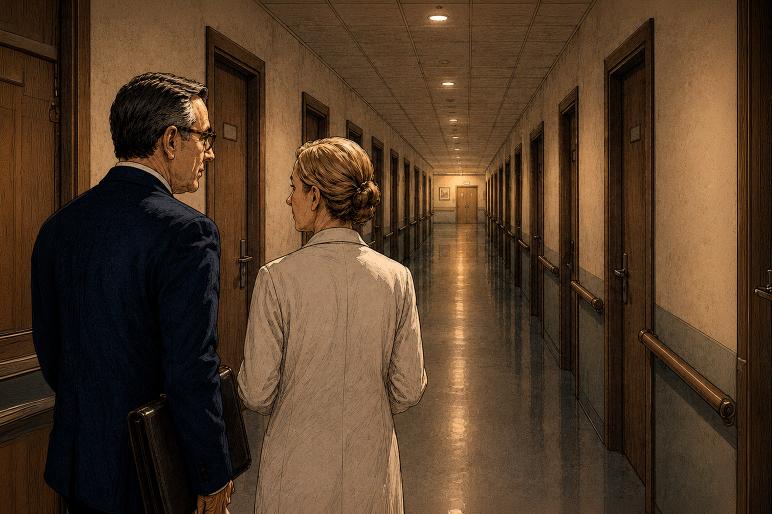
The director of the facility was accompanying me to the room of the person I was due to meet. At a certain point, we entered a corridor that was different from all the others. The silence struck me immediately.
The lights were dim. Every door was closed. No voices could be heard. There were no residents in the corridor. No relatives. No communal rooms. There was absolutely nothing.
We continued walking through that almost unreal silence. The further we went, the stronger became a feeling inside me that was difficult to describe. Eventually, unable to understand what I was seeing, I asked the director for an explanation.
Her answer affected me deeply.
“This is the ward for people in a coma.”
For a few moments, I was speechless. Behind each of those doors was a person who, for months or even years, had been living suspended on a boundary that is difficult even to imagine. People kept alive through continuous care, entrusted every day to doctors, nurses and healthcare staff.
I began walking again. That corridor seemed even quieter than before. But it was not an empty silence. It was a silence filled with lives, with stories, with families who continued to wait, to hope, to remain beside their loved ones even when it was no longer possible to receive a look or a word in return.
I reached the room of the person who was waiting for me in a completely different frame of mind from the one in which I had entered the facility. The legal act I had gone there to receive almost faded into the background. It was that corridor that remained with me.
Even today, whenever I enter a care home, I think back to that place. It reminds me how fragile the human condition is. And it also reminds me how precious are all those people who, far from public attention, devote their lives every day to caring for those who can no longer ask for anything, can no longer speak and, perhaps, can no longer even say thank you.
It is one of the most powerful images I carry with me after so many years in the profession. An image that says nothing about law. It speaks simply about life. And about the respect every life deserves, even when silence seems to have taken the place of every word.