Behind-the-Door-Next-Door
There are people who spend their entire lives accumulating things.
I am not talking about collectors, people who gather stamps, coins, antique books or any other objects out of a passion they may have pursued for decades.
I am talking about something entirely different.
People who can hardly bring themselves to part with anything. Who keep everything, even things that, to anyone else, have long since lost all usefulness. And who, day after day, year after year, end up filling their homes until they become almost uninhabitable.
Over the course of my career, I have met several such people.
And each encounter has been difficult to forget.
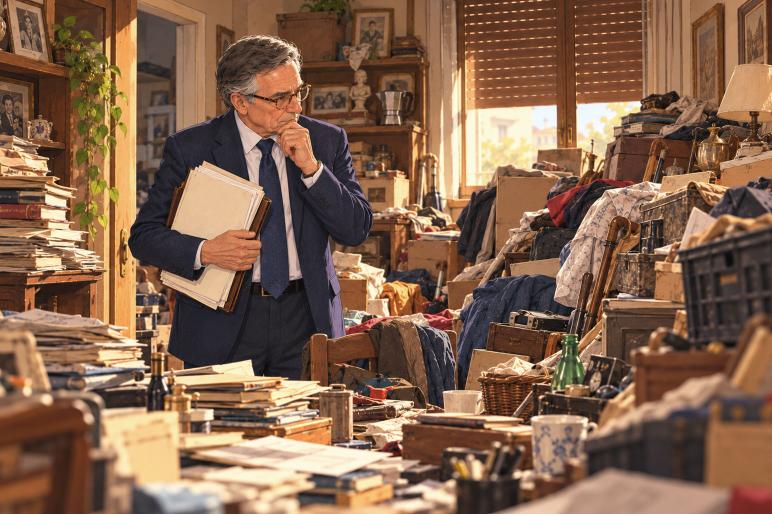
Imagine entering a house where the floor has almost disappeared beneath mountains of possessions.
Clothes piled on top of one another, not in wardrobes or drawers but directly on the floor. Empty bottles, newspapers, cardboard boxes, wooden and plastic fruit crates, bags, old tools, papers of every description.
The beds are covered with blankets, clothes and objects. The tables can no longer be used. Chairs have become supports for yet more piles of things.
Sometimes the shutters have been closed for who knows how long, and daylight can barely find its way inside.
To cross a room, you have to find a path, turn sideways, step over things and watch where you put your feet.
And in the midst of all this, someone lives.
I have often pictured a little bird that, having filled its nest with everything it has gathered, finds itself confined to one tiny corner.
The image may seem exaggerated.
But I assure you that some homes are exactly like that.
I have even had to execute notarial deeds in homes of this kind, with the person concerned present, physically searching for somewhere to lay out the documents while weaving between mountains of clothes, boxes and objects of every kind.
Places where the ordinary organisation of a home seems to have vanished altogether.
And yet, for the person living there, it is home. It is their world. A reality built up slowly, perhaps over decades, from which they evidently cannot detach themselves.
I do not know the deeper reasons behind such behaviour. There may be psychological difficulties, loneliness, deeply ingrained habits or personal histories that an outsider cannot know.
As a notary, after all, it is not my role to make diagnoses.
I am there to do my job.
But it is impossible not to be affected.
And sometimes, beyond the accumulation of objects, I have encountered another situation, in some ways even more astonishing.
People living in conditions of extreme deprivation, apparently without any financial means at all.
Men and women who, to those who knew them, were simply destitute. People who seemed to need everything, who sometimes received assistance, who ate whatever they could manage and spent virtually nothing on themselves.
I even remember a home without an indoor bathroom. The toilet was still out in the courtyard, as in some old country houses many decades ago.
Conditions that today might seem to belong to another age.
And yet they still exist.
Then, one day, that person dies.
And another story begins.
The notary becomes involved. The deceased's financial affairs are reconstructed, documents examined, assets identified and the checks required for the succession carried out.
And suddenly something comes to light that nobody could have imagined.
The man who had lived almost like a beggar owned extensive tracts of land.
The person who seemed not even to have enough money to live with dignity had hundreds of thousands of euros in the bank.
Sometimes the assets were truly substantial.
It has happened to me more than once.
And I remember the astonishment of those who discovered the truth.
The incredulous looks, the questions, the almost instinctive repetition of the same words: “How is that possible?”
How could someone who possessed so much have spent an entire lifetime living in those conditions?
How could they have gone without so many comforts, even the most basic ones, when they could have afforded a completely different life?
The questions arise naturally.
But they are far from easy to answer.
Because our relationship with money, objects, ownership and the fear of losing something is rooted in the deepest parts of our personal histories.
And what seems incomprehensible from the outside is not necessarily so to the person living that life.
Perhaps those people simply could not bring themselves to spend. Perhaps ownership gave them a sense of security that no purchase could ever provide. Perhaps they were merely habits that, over the years, had become impossible to change.
I do not know.
Nor do I think it is right to insist on explaining it.
I only know that, at times, I have been confronted with a painful paradox: someone who had the financial means to live comfortably, yet had spent the final years of their life in conditions that many of us would struggle to endure for even a few days.
Then comes the question of inheritance.
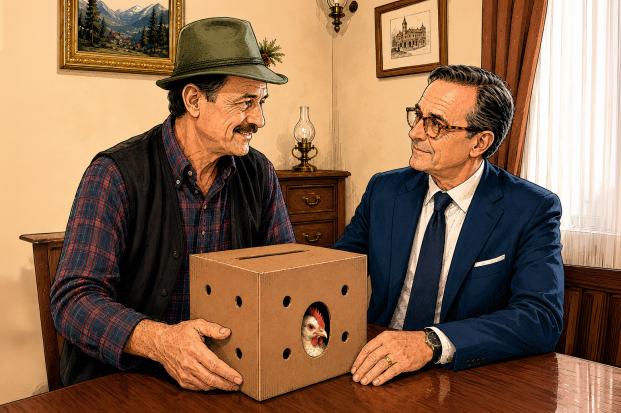
Perhaps there are no children, no spouse, no one particularly close.
Relatives are sought out, family relationships reconstructed and heirs identified.
And it may happen that a distant relative, who perhaps had very little contact with that person, suddenly finds themselves inheriting an unexpected fortune.
Rather like the old stories of a rich uncle in America.
Except that here the rich uncle had not lived in a grand villa on the other side of the ocean.
He might have been the elderly gentleman at the end of the street, in the house with the shutters always closed, whom everyone knew by sight and no one would ever have imagined was wealthy.
Of course, not everyone who hoards objects has hidden wealth. And not everyone who lives in extreme poverty is, in fact, well off.
But the few occasions on which I have encountered these situations have left a profound impression on me.
Because the thought that keeps returning to me is not really about money.
It is about life.
I think of those people, of the years spent in increasingly cluttered rooms, of the spaces growing smaller, of the objects continuing to accumulate until they could barely move freely around their own homes.
I think of everything they might have done, the comforts they might have allowed themselves, the small everyday pleasures they may never have enjoyed.
And I wonder whether they were happy.
It is a question I will never be able to answer.
Perhaps they were, in their own way.
Perhaps that life, which seemed so difficult to me, represented the only balance they could find.
But a feeling of sadness remains, especially when I think of the loneliness that sometimes accompanied those lives.
And there is something else that strikes me.
Those houses are not necessarily in remote places, far away from everyone.
They may be in an apartment building, on a village street, in an entirely ordinary building.
Perhaps a family with children lives on the first floor, a retired couple on the second, and someone who leaves for work every morning on the third.
Life goes on as usual.
People meet on the stairs, greet one another and exchange a few words about the weather.
And behind one of those doors there may be a completely different world.
Someone living surrounded by mountains of objects, barely able to use their own bed or kitchen, perhaps possessing considerable wealth and yet continuing to live as though they had nothing.
Just a few metres away from us.
And we have no idea.
Perhaps this is the reflection that has stayed with me more than any other.
My profession has sometimes led me through doors that would normally have remained closed. It has allowed me to witness aspects of human existence that I would hardly have encountered in everyday life.
And each time it has reminded me how little we truly know about the people around us.
We can live next door to someone for thirty years without knowing anything about their life.
We can pass them every morning, greet them, perhaps judge them by the way they dress or the conditions in which they appear to live.
And know almost nothing about them.
Not know what they own, certainly.
But, above all, not know what fears, hardships, memories or loneliness lie hidden behind that door.
When these people die, what often remains is a mountain of possessions to be cleared away and an estate to be divided.
Bank accounts are closed, land passes to the heirs, houses are emptied.
Wealth, financial wealth, almost always finds someone ready to receive it.
But of the life lived within those four walls, of what that person felt, longed for or feared, often almost nothing remains.
And so I wonder whether the real surprise in those stories was discovering that a man considered desperately poor possessed hundreds of thousands of euros.
Or whether the greater surprise was realising that he had lived for years just a few metres from all of us, without anyone ever truly knowing his world.
Because sometimes, to encounter a reality we could never have imagined, we do not need to travel far.
We need only open the door next door.